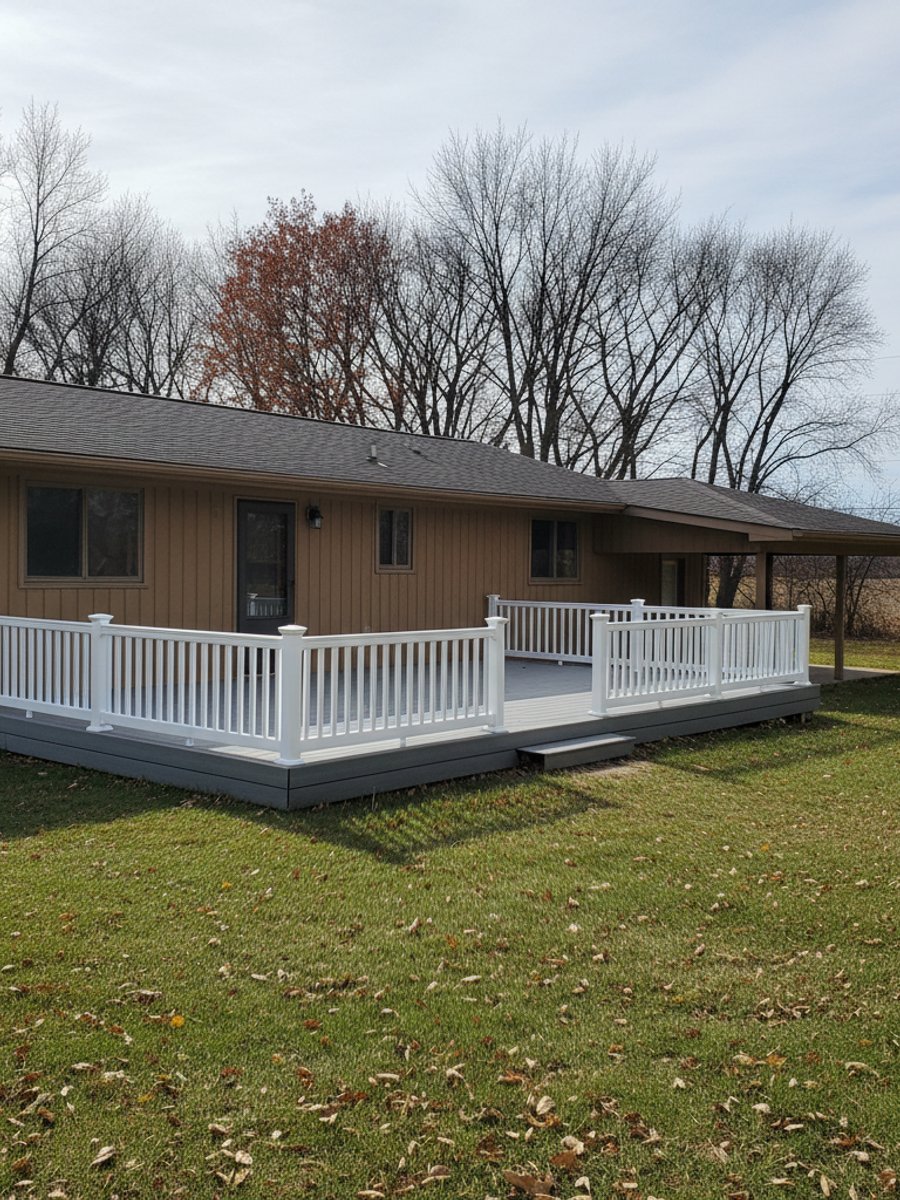
A deck looks simple from the outside. Boards, joists, some posts, a rail. What you can't see from the yard is the part that decides whether it's still standing square in fifteen years: the footings, the fasteners, and whether the guy who built it actually understood the ground he was digging into. In Fitchburg that ground has opinions.
What the ground and weather here actually do to a deck
Dane County soil is mostly clay-heavy, with pockets of silty loam depending on where you are relative to the old glacial till. Clay holds water. When it's wet it swells, when it dries out it shrinks, and when it freezes it heaves. A deck post sitting on a footing that doesn't go deep enough will get pushed up over a few winters, sometimes as little as a quarter inch a year, and you won't notice until the whole structure is out of level and the ledger board is pulling away from the house. This is the single most common failure I see on decks that were built cheap or built fast.
Add to that a real Wisconsin winter. Fitchburg gets somewhere around 100+ freeze-thaw cycles a year once you count every dip below and above freezing from November through March. Every one of those cycles is a chance for water trapped in a crack or a bad joint to expand and make the crack worse. Summers are humid, which matters for staining and sealing, and the window where wood is dry enough and warm enough to take a stain properly is narrower than people think, usually late May through September.
Footings and frost depth, not the part anyone asks about
Dane County code requires footings to sit below the frost line, which around here runs roughly 42 to 48 inches deep. That's not a suggestion. A footing that stops at 24 or 30 inches because it was faster to dig will move. I've seen decks less than five years old with a visible slope toward the house because the footings were shallow and the frost pushed the low corner up unevenly.
Ask any builder you're talking to how deep they dig footings and what diameter tube they use. If the answer is vague, or if they tell you deck blocks sitting on the surface are fine for a full-size deck attached to the house, that's a walk-away moment. Surface blocks have their place on a small freestanding platform a few inches off the ground. They don't belong under a 300-square-foot deck with a hot tub on it.
Permits and inspections in Fitchburg
Most decks attached to a house in Fitchburg need a building permit through the city, and the city will typically want to see the footing holes before they're poured, then a framing inspection before the boards go down, and a final once the rail and stairs are up. If your lot backs up to a setback line or an easement, which is common in the newer subdivisions south of the Beltline that were built on former farmland, the plan review will check that too. A builder who tells you permits are optional, or who offers to skip the inspection to save time, is putting the liability on you, not on them. If something fails later and there's no permit on file, that's your problem with your insurance company, not theirs.
HOAs aren't universal in Fitchburg the way they are in some newer suburbs, but several of the newer developments do have architectural review for anything visible from the street, deck height and railing style included. Worth checking before you fall in love with a design.
What separates a real deck builder from a guy with a truck
Fitchburg has a mix of housing stock. Older streets near the original village center have houses from the 60s and 70s where the existing deck, if there is one, was probably built before current frost-depth code even applied, so a repair or resurfacing job there often turns into a footing problem the minute you open things up. Newer subdivisions have houses under 20 years old where the original deck is aging out of its treated lumber and starting to show the fastener corrosion and post rot that shows up right around the 15 to 20 year mark.
- Ask to see the footing depth and post size they'd spec for your specific deck, not a generic number. A second-story deck carries different loads than a ground-level platform.
- Ask whether they use structural screws or nails for the ledger connection, and whether they flash the ledger where it meets the house. An unflashed ledger is the number one cause of hidden rot behind a deck, because water gets between the board and the siding and just sits there.
- Ask what fasteners they use with treated lumber. Modern pressure-treated wood is processed with a copper-based preservative that corrodes plain steel and even some galvanized coatings within a few years. It needs stainless or ACQ-rated hardware.
- A quote that's dramatically lower than everyone else's is usually lower because something's missing: proper footings, code-compliant railing height, joist hangers instead of toe-nailed joists.
- Get it in writing what happens if they hit rock, or an old buried footing, or a utility line while digging. It happens more than you'd think on older lots.
Material choices worth thinking through before you sign
Pressure-treated lumber is still the most common frame material and it's a reasonable choice, but it needs to be sealed within the first year and re-sealed every two to three years after that or it'll gray and check. Composite decking costs more up front, sometimes close to double the material cost of wood, but it doesn't need staining and holds up better to the freeze-thaw cycle since it doesn't absorb water the same way. Railing is where people cut corners without realizing it. Code in Wisconsin generally requires 36-inch railing height for most residential decks, with baluster spacing that won't let a 4-inch sphere pass through, which matters if you have small kids or pets.
None of this is complicated once you know to ask about it. The problem is most homeowners don't find out a deck was built wrong until it's ten years old and starting to lean. A good builder will walk you through footing depth, ledger flashing, and material trade-offs without being asked twice, because it's the part of the job that actually matters. That's the conversation to have before anyone breaks ground, and it's the kind of thing we walk through on every job, whether it's a small resurfacing project or a full multi-level build. If you want to see how we approach that conversation, Majestic Deck Solutions is a good place to start.